
Having access to your money feels reassuring.
But sometimes flexibility can make it harder to reach the goals you're saving for. As your balance grows, it's worth asking whether every dollar should remain immediately available.
Understanding the difference between a savings account and a certificate of deposit (CD) can help you decide when accessibility matters most and when protection may be the smarter choice.
Whether you're saving for a home down payment, a major renovation, a future vehicle purchase, or another big goal, choosing the right account can help keep your savings on track.
Start at the beginning: Learn how a "do not touch" savings strategy protects long-term goals >
Why Flexibility Isn't Always the Best Option
A savings account is designed to keep your money accessible. That's why it's often recommended for emergency funds and short-term financial needs.
When unexpected expenses arise, having quick access to cash can provide valuable peace of mind. A savings account also lets you continue adding money whenever you're able.
However, unlimited flexibility isn't always an advantage.
Money that's easy to access is easier to spend. A few withdrawals here and there may not seem like much, but they can slow progress toward larger financial goals.
If you're saving for something important in the future, it's worth considering whether convenience is helping or hurting your commitment to that goal.
What Is the Difference Between a CD and a Savings Account?
When comparing a CD vs. a savings account for saving money, the biggest difference comes down to access.
A savings account lets you deposit and withdraw funds as needed. While interest rates may change over time, your money remains available when you need it.
A certificate of deposit works differently. You agree to leave your money in the account for a specific period, known as a term. In return, you receive a fixed rate for that term.
Because the money is intended to stay in place until maturity, a CD can create more separation between you and the funds you're saving for a future goal.
That structure can make it easier to stay focused on the purpose of the money instead of viewing it as available for everyday spending.
When Should I Use a CD Instead of a Savings Account?
There's no one-size-fits-all answer. The right choice depends on your goals, timeline, and need for access.
Here are a few signs that a CD may be the better fit.
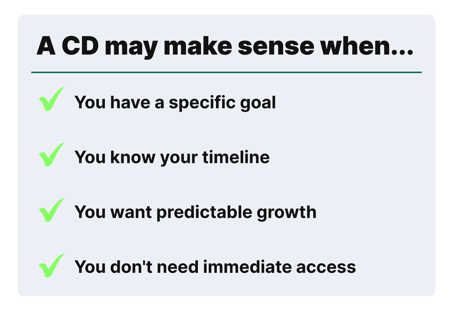
You Have a Specific Savings Goal
Saving feels different when the money has a clear purpose.
Maybe you're planning for a future home purchase. Perhaps you're saving for a kitchen renovation, a new vehicle, or education expenses.
When you know exactly what the money is for, a CD can help reinforce that commitment by giving those funds a dedicated place to grow.
You Know When You'll Need the Money
One of the biggest advantages of a CD is the ability to match your savings to a future timeline.
For example, if you're planning to purchase a vehicle in two years or start a renovation project next summer, a CD term may align with your anticipated goal date.
Having a defined timeline can make it easier to determine whether locking in funds for a period makes sense.
You Want More Predictability
Many savers appreciate knowing exactly how their money will grow. A CD provides a fixed rate for a fixed term, which creates greater certainty when planning for future expenses.
If predictability is important to you, a CD can provide added confidence as you work toward a long-term savings goal.
You're Tempted to Dip Into Savings
Not every savings challenge is about earning more money. Sometimes the biggest challenge is simply leaving savings alone.
If you've found yourself repeatedly borrowing from goal-based savings for unrelated purchases or expenses, a CD may help create a helpful barrier between your everyday spending habits and your long-term plans.
When a Savings Account May Be the Better Choice
A CD isn't always the right answer.
A savings account may be a better fit if you need the flexibility to access your money at any time. For example, emergency funds typically belong in a savings account because unexpected expenses rarely arrive on a predictable schedule.
You may also prefer a savings account if:
- You're still building your emergency fund.
- Your timeline is uncertain.
- You expect to need the money soon.
- You'll be making regular withdrawals.
- You're saving for multiple short-term goals.
Flexibility serves an important purpose. The key is making sure it supports your financial goals rather than making them harder to achieve.
Using Both Accounts Together
The good news is that choosing between a CD and a savings account doesn't have to be an either-or decision. Many people use both.
A savings account can hold emergency funds and money that may need to remain accessible. A CD can be used for money dedicated to future goals with a defined timeline.
Think of it as giving every dollar a job.
Money you need access to stays flexible. Money intended for future milestones receives additional structure and protection.
This approach can help balance accessibility with long-term progress while creating more clarity around your savings strategy.
The Right Choice Depends on Your Goal
When comparing a CD vs. savings account, the better option isn't always the one with the most flexibility.
The real question is what your money needs to do.
If you need access at any moment, a savings account may be the right choice. If you're saving for something important in the future and want additional structure, a CD may help protect your progress while giving your money time to grow.
Now that you know the options, be sure to look at our savings and CD options.